Crash Sites (Local)
Lancaster W4244 QR-F (No. 61 Squadron, Bomber Command)
Operation: Gardening
Date: 10 November 1942
Base: RAF Syerston, Nottinghamshire
On the evening of 10 November 1942, Avro Lancaster W4244 QR-F of No. 61 Squadron, Bomber Command, took to the skies from RAF Syerston at 17:30 local time. The mission was a ‘Gardening’ operation—RAF code for aerial mine-laying—targeting the Gironde estuary off the coast of France. These operations were critical to disrupting enemy shipping routes and supply lines.
Despite challenging conditions—low visibility, persistent drizzle, and only 8% moonlight—the crew successfully completed their task and turned for home. As they approached the southwest coast of England, deteriorating weather and poor ground visibility forced a diversion to RAF Exeter. Attempting to land on runway 27 from the northeast, the aircraft joined the circuit near Honiton.
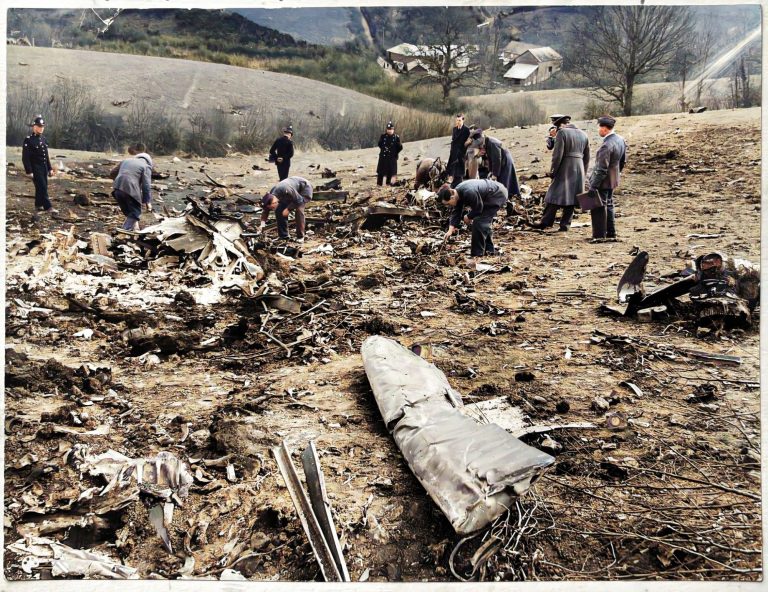
Tragically, during the final approach, the pilot misjudged the descent. Lancaster W4244 struck farmland near the airfield, resulting in the loss of all seven crew members.
Crew of Lancaster W4244 QR-F
Pilot Officer Paul Campbell – Pilot
Sergeant John Leslie Jackson – Flight Engineer
Sergeant Ernest Humphries Corbett – Navigator
Sergeant Frank Charles Bunclark – Observer
Sergeant Cyril Hugh Coakley – Wireless Operator
Sergeant Leslie Littlewood – Air Gunner
Sergeant Eric Edward Bartholomew – Air Gunner
These young men served with courage and dedication, embodying the spirit of No. 61 Squadron, whose motto was: “Thundering Through The Clear Air.” Their sacrifice, like so many others, remains etched in the legacy of Bomber Command and the defence of freedom.
Lest We Forget.
Sources –
Initial email from Ian Jeeves - Thank you
Bureau of Aircraft Accidents Archives
ORBs from the National Archives reference AIR 27/577/45 and AIR 27/577/46
The International Bomber Command Centre website at Discovery, Education and Remembrance | IBCC
Lancaster crash Exeter 1943:
F/Sgt Stanley Gawler DFM
The RAF Hornchurch Heritage Centre has had the log book of F/Sgt Stanley Gawler DFM (1295418) donated to them, he was from Dagenham. Gawler died when his Lancaster aircraft was lost on 3rd September 1943. It seems likely that it crashed following a structural failure. The crash site was described as roughly 3/4 mile SW of Exeter.
Gawler had completed a tour with 50 Squadron as part of P/O Thomas Bernard Cole's crew, and was on board as an air gunnery instructor at 1661 HCU. The aircraft Stanley was lost in was Lancaster R5492, which had previously been with 44 and 106 Squadrons. The RAF Metheringham museum published a photo of the aircraft on Twitter in 2020, which showed it as being known as ZN-S for "Shocker".
The form 1180 accident card states that the aircraft crashed following being coned in searchlights over Exeter and that the pilot lost control trying to evade the lights. I have seen that it may have been shot down by friendly fire, and also that the "tired" aircraft suffered a structural failure.
I have since found out the crew were carrying out searchlight evasion training and lost control following a structural issue. No mention of friendly fire.
Crew listings:
Sergeant Dennis Sydney AUDLEY (1576642) Wireless Op
1943-09-03
1661 HCU
Died
Commemorated Birmingham (Handsworth) Cemetery, United Kingdom
Pilot Officer John Franklin CURTIS (412231)
1943-09-03
1661 HCU
Died
Commemorated Bath (Haycombe) Cemetery, United Kingdom
Flight Sergeant Stanley Alfred GAWLER (1295418) Air Gunner
1943-09-03
1661 HCU
Died
Commemorated Barking (Rippleside) Cemetery, United Kingdom
Pilot Officer Samuel Keith LOWRY (400559)
1943-09-03
1661 HCU
Died
Commemorated Exeter Higher Cemetery, United Kingdom
Sergeant Leslie John MILTON (1583502) Flight Engi
1943-09-03
1661 HCU
Died
Commemorated Morden Cemetery, United Kingdom
Flight Sergeant Thomas David PHILLIPS (18297)
1943-09-03
1661 HCU
Died
Commemorated Exeter Higher Cemetery, United Kingdom
Flight Sergeant Laurence Alexander TAYLOR (414967)
1943-09-03
1661 HCU
Died
Commemorated Bath (Haycombe) Cemetery, United Kingdom
Sergeant Arthur YOUNG (2206984) Air Gunner
1943-09-03
1661 HCU
Died
Commemorated Bradford (Thornton) Cemetery, United Kingdom
Below - The two graves of Flight Sergeant T D Phillips RAAF and Pilot Officer S K Lowry RAAF who are buried at the Exeter Higher Cemeterey, Exeter, Devon.


Dawlish:
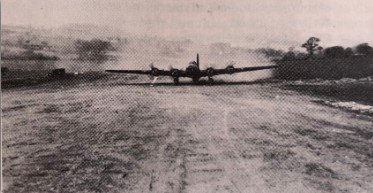
The Mighty Eighth as they were known had a casualty of the French coast submarine pen missions. A B17 Flying Fortress of the 303rd suffered damage from the Luftwaffe who were using new tactics attacking simultaneously from two sides of the bombers. This proved costly as they ended up sending down five of the Allied bombers. One B17 named 'Werewolf' limped across the channel after being damaged by flak and managed to reach the South West coast of England. Lt. George J. Oxrider ordered his crew to bail out as the aircraft struggled to stay aloft. He managed to land the stricken bomber safely in a small field of greens at Dawlish, South Devon. Now normally a successful emergency landing resulted in the aircraft being dismantled and taken away by road, on this occasion however, Service Command decided to fly this ‘Werewolf’ out again after a few repairs were carried out on site. Three engines were changed whilst US Engineers made a clearing by cutting down trees, hedges and even walls to make a temporary runway. Two weeks after the landing ‘Werewolf’ was successfully flying again after a successful take off from Dawlish and it returned to Molesworth Airfield.
Information sourced from the book 'The Mighty Eighth' by Roger A Freeman.
A B17 Flying Fortress taxis out from a make shift field in Dawlish, Devon.
Spain Farm, Aylesbeare:
Spain Farm Aylesbeare on the 21 March 1943, was sadly the location of a crash involving Mosquito aircraft NFII EW-V DZ261. Sadly, the pilot and Observer who were members of the 307 Polish Squadron based at RAF Exeter, were killed in the incident. The crash came about when Wing Commander Michalsowski and his Observer Flying Officer Szkop were demonstrating how to land on one engine. They took off on what was then runway number 3 which was later changed to 31 and completed a circuit to land on a single engine. The approach for that runway would bring them in over the village of Aylesbeare and indeed Spain Farm. After shutting down one engine they began their approach and descended to 430ft and lined up with the runway. At the same time, it was reported that an aircraft movement either under its own power or being towed enter runway 3. The Air Traffic Controllers noticed this and fired a red flare to indicate to the approaching Mosquito to ‘go around’. Eye-witness accounts say that the Mosquito pitched up on a single engine and then appeared to flip over and disappear from site. The aircraft crashed into a field belonging to Spain Farm and both occupants were killed instantly. The split seconds to react when the aircraft was configured for landing i.e. Flaps and undercarriage down would have contributed to increased drag especially on only one engine and the chances of a stall would be very high.
Information sourced from a research report by Jerry Bird.

Page updated on the 25 March 2026